

Categories
Domain appraisals Domain market

What Actually Drives a Domain Appraisal

Type a name into a domain appraisal tool and it spits out a number, $1,200, or $47,000, or $85. Where does that come from? It can look like a slot machine, but a domain valuation is mostly a small set of understandable factors, weighted and then anchored to real sales of similar names. Once you can see the factors, the numbers stop being mysterious and start being arguable, which is exactly what you want when you’re buying, selling, or naming something.

Here’s what actually goes into the reasoning.

The one factor that dominates everything: comparable sales

Before the individual attributes, understand the anchor. A domain is worth what similar domains have actually sold for. Every serious appraisal, human or automated, is ultimately a comparison to a dataset of real transactions (Sedo, Afternic, GoDaddy Auctions, NameBio’s public sales archive, and so on).

The attributes below matter because they predict which sales your name is comparable to. Short, dictionary-word .coms cluster in one price band; long hyphenated names cluster in another. An appraisal is really answering: “which pile of past sales does this name belong to, and where in that pile?” Keep that in mind, it’s why two names with identical “scores” on paper can be valued very differently once real comps are pulled in.

Length: shorter is worth more, sharply

Length is the single most legible driver, and its effect is steep.

  • Ultra-short (1–4 characters). The premium tier. Three- and four-letter .coms (LLL.com, LLLL.com) and short numeric names have their own established markets and floor prices, a random pronounceable LLLL.com has a known baseline in the low thousands, purely for its length and scarcity. There are only so many of them; scarcity does the work.
  • Short (5–8 characters). Still valuable, especially if it’s also a real or brandable word. This is where most premium brandable names live.
  • Medium (9–15). The vast middle. Value now depends heavily on what the word is, not just how long.
  • Long (15+ / multiple words). Value drops fast. Long, multi-word domains are cheap unless the phrase itself is high-intent (see keywords below).

Rule of thumb: every character you add makes a name a little less memorable, less typeable, and less scarce. Length compresses value from both ends, memorability and rarity.

TLD: .com is still the gravity well

The extension may be the second-biggest factor after length.

  • .com is the reference standard. It commands a large premium over everything else because it’s the default people type and trust. In most comp datasets, the .com sells for several times what the identical .net or .org would.
  • .net, .org, meaningful but distant runners-up, with .org carrying weight for nonprofits/communities.
  • New gTLDs (.io, .ai, .app, .dev, .xyz, …), these have their own markets, and the good ones can be very valuable in-context (.ai right now, .io for tech). But a new-gTLD valuation is judged against comps within that TLD, not against .com. A great .xyz is priced as a great .xyz, not a discounted .com.
  • ccTLDs, valued within their own ecosystem and subject to the geopolitical caveats that come with country codes.

The practical consequence: the same string can be worth 10× more on .com than on a fringe extension. TLD isn’t a modifier on top of the name, it partly is the name’s market.

Dictionary word vs. brandable vs. random

What kind of string it is drives which market it plays in.

  • Dictionary / real-word domains (ladder.com, orbit.com). Premium. A single common English word on .com is inherently scarce and instantly meaningful, these are the trophy names, often five and six figures and up. One-word .coms are effectively all registered; acquiring one means buying it from someone.
  • Keyword / high-intent phrases (carinsurance.com, bestvpn.com). Valued for commercial intent, the traffic and lead value the phrase implies. Here, length matters less and the money-making potential of the exact words matters more. Type-in traffic and SEO relevance drive these.
  • Brandable invented names (Spotify, Twilio, Klarna-style). No dictionary meaning, but pronounceable, short, and ownable. This is the fastest-growing category because startups need trademarkable names. Value comes from how good it sounds and how cleanly it could become a brand, pronounceability, spelling-on-hearing, uniqueness.
  • Random strings (x7gqmp.com). Little value beyond whatever their length tier gives them (a short one still has floor value as a short domain).

Pronounceability and syllable count

For brandables especially, how the name sounds is a real, weighted factor.

  • Syllable count: one- and two-syllable names are gold; three is fine; beyond that memorability decays. Short-and-sayable is the brandable ideal.
  • Pronounceability: can someone say it correctly on first sight? Can they spell it correctly on first hearing (the “radio test”)? Names that pass both are worth more because they’re cheaper to market, less confusion, fewer lost visitors.
  • Phonetic patterns: alternating consonant-vowel patterns (like “Zaneo,” “Ravio”) read as brandable and pronounceable; consonant clusters hurt.

This is why an invented name with no dictionary meaning can still appraise higher than a real but clunky compound word: it performs better as something a human will say, type, and remember.

The penalties: hyphens and numbers

Two features reliably drag a valuation down.

  • Hyphens. A hyphen is a significant penalty. my-shop.com is worth a fraction of myshop.com. Hyphens signal that the clean version was taken, they’re forgotten when typing, they’re awkward to say aloud (“my dash shop”), and they read as lower-trust. Multiple hyphens compound the damage.
  • Numbers. Mostly a penalty, with exceptions. Numbers create ambiguity (“4” vs “four”, which did they mean?) and hurt the radio test. But: short all-numeric domains (especially in markets like China, where numeric domains carry cultural and practical weight) have their own strong market, and a number that’s part of the brand (7-Eleven, 500px) can be fine. The penalty applies most to numbers used as substitutes (“gr8,” “4you”) in otherwise-word names.

Both features push a name out of the premium comp piles and into cheaper ones, which is why the automated score drops when you add them.

Everything else that nudges the number

Secondary factors that move a valuation up or down:

  • Keyword search volume / commercial intent, high for the “carinsurance” category, near-zero for random brandables.
  • Existing traffic, a name already getting type-in visitors is worth more (it’s a cash flow, not just a string).
  • Age and history, an aged domain with clean history can carry SEO value; a name with a spammy or penalized past is worth less than a fresh one.
  • Trademark conflicts, a name that infringes an existing mark isn’t an asset, it’s a liability; it drags value to near zero (or negative, given legal exposure).
  • Trend alignment, names matching a current wave (AI, crypto in its moments) spike with demand and can fall just as fast.
  • Spelling variants, the correctly-spelled, obvious version beats creative misspellings.

How the factors combine

A real appraisal doesn’t just add these up, it uses them to place the name among comparable sales and then reads the price off that neighborhood:

  1. Start from length and TLD to establish the broad tier (a short .com vs. a long .xyz are in different universes).
  2. Classify the string, dictionary word, keyword phrase, brandable, or random, to pick the right market.
  3. Score the soft factors, syllables, pronounceability, hyphens, numbers, to position within that market.
  4. Anchor to comparable sales, pull real transactions of names in the same tier/market/quality and land on a figure.
  5. Adjust for the specials, traffic, trademark risk, trend heat, history.

That’s the whole machine. It’s why orbit.com is a five-or-six-figure name (short, dictionary word, .com, one comp pile) and the-best-orbit-deals-4u.net is worth a rounding error (long, hyphens, number-substitution, .net, an entirely different and cheaper comp pile), even though both contain the word “orbit.” Run your own name through and the figure that comes back should now be legible: you’ll see where the length tier put it, what the TLD did, and whether hyphens or numbers cost it.
Categories
DNS WHOIS

The Full Lifecycle of an Expiring Domain

A domain doesn’t blink out of existence the day it expires. It falls through a sequence of well-defined stages, each with its own rules about who can recover the name and what it costs. If you’re the owner who forgot to renew, knowing this timeline is the difference between a $10 late renewal and a $200 redemption fee, or losing the name entirely. If you’re trying to acquire an expiring name, it tells you exactly when (and whether) you’ll get a shot.

Here’s the whole path, stage by stage, with the day counts that actually apply to most gTLDs like .com, .net, and .org.

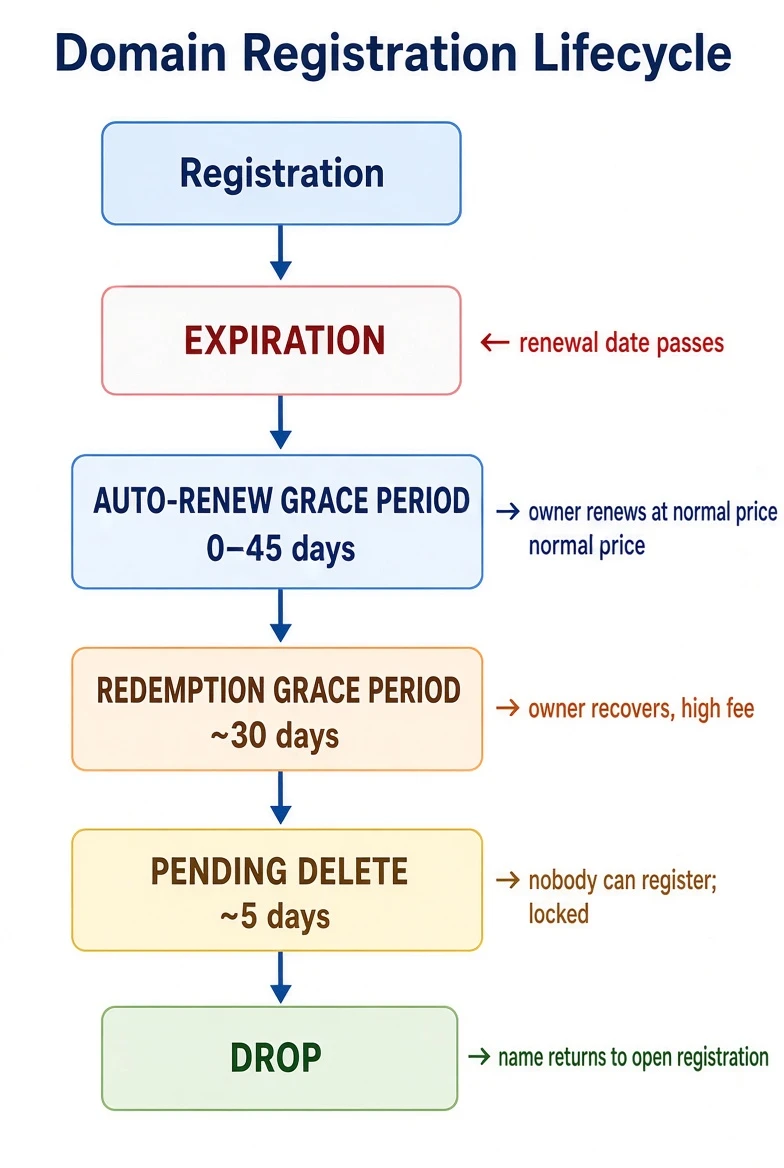
The timeline at a glance

domain registration lifecycle

Stage 1, Expiration and the auto-renew grace period (0–45 days)

The domain’s registration date passes without a renewal. The name doesn’t immediately stop working, and it’s very much still the registrant’s.

  • What happens: Most registrars auto-renew by default, or place the domain into an Auto-Renew Grace Period of up to 45 days (the exact length is set by the registrar within registry rules). During this window the site may keep resolving, or the registrar may park it on a “this domain expired” landing page.
  • Who can recover it: Only the original registrant, and typically at the normal renewal price. This is the cheap, easy window. Renew now and it’s as if nothing happened.
  • The catch: Many registrars start layering on urgency and, near the end of the window, late renewal fees. Don’t count on the full 45 days at base price, check your specific registrar.

If you want the name: you can’t have it yet. It still belongs to the current owner, who holds all the recovery rights.

Stage 2, Redemption Grace Period (~30 days)

If the owner still hasn’t renewed, the registrar deletes the domain from its side, and the registry places it into the Redemption Grace Period (RGP), lasting about 30 days.

  • What happens: The domain stops resolving entirely. DNS is pulled; the site and email go dark. In RDAP/WHOIS the status reads redemptionPeriod.
  • Who can recover it: Still only the original registrant, but now it’s expensive and manual. Recovery means asking the registrar to redeem the name, which usually carries a redemption fee of $80–$200+ on top of the renewal. It’s deliberately punitive; ICANN designed RGP so accidental expirations can be undone, not so names cycle cheaply.
  • Who can’t: No one else. The name is not available to register. Any “backorder” you place is just a queued request for later, you cannot take it now.

This is the last exit for the owner. Miss redemption and the name is effectively gone from your control.

Stage 3, Pending Delete (~5 days)

Redemption lapses. The registry moves the domain to Pending Delete, a fixed period of about 5 days.

  • What happens: The name is locked and inert. Status reads pendingDelete.
  • Who can recover it: Nobody. Not the former owner, not a new registrant. There is no action anyone can take during these five days. It’s a countdown.
  • Why it matters: Pending Delete is the starting gun for the drop-catching industry. Because the period is a fixed length, the exact moment the name will drop is predictable to the second, and that predictability is the whole game for the people who want it.

Stage 4, The Drop

At the end of Pending Delete, the registry deletes the name and returns it to the available pool. In that instant, it’s registrable by anyone on a first-come, first-served basis.

For an unremarkable name, it just quietly becomes available and you can register it normally. For a desirable name, “first come” is a war fought in milliseconds.

Where the name can be recovered vs. caught, the summary

Stage Duration Former owner Anyone else
Auto-renew grace 0–45 days ✅ Recover at normal price ❌
Redemption (RGP) ~30 days ⚠️ Recover, high fee ❌
Pending delete ~5 days ❌ ❌
Drop instant — ✅ First come, first served

The single most useful takeaway: for roughly the first ~75 days after expiry, only the original owner can get the name back. Everyone else is waiting for the drop. If you’re monitoring a name you want, what you’re really tracking is when it will reach the end of pending delete, the only moment it becomes catchable.

Drop-catching: how “first come” really works

When a valuable name drops, thousands of registrations may be attempted in the first second. The players who win are drop-catch registrars, companies that hold many ICANN registrar accreditations specifically so they can fire enormous volumes of registration attempts at the registry the microsecond the name releases. Services like SnapNames, DropCatch, and Pool.com operate exactly this way.

As a normal buyer, you don’t compete with them by hand. You place a backorder with one of these services before the drop. If they catch it and you were the only backorderer, you get it at their base price. If multiple people backordered the same name, it goes to a private auction among those backorderers.

Where auctions come in

There are really two distinct auction markets, and they attach to different points in the lifecycle:

1. Expired-domain auctions (registrar-run, before the drop). This is the big one. Rather than let valuable expiring names fall to third-party drop-catchers, large registrars auction them off during the expiry window, while the name is still technically the lapsed owner’s, in that grace/redemption zone.

  • GoDaddy Auctions is the largest expired-domain marketplace. Names that expire at GoDaddy (and partner registrars) flow into public auctions before they’d ever reach pending delete. Win the auction and GoDaddy renews the name into your account, it never actually drops.
  • Namecheap Market (and its Marketplace/auction features) similarly lists expiring and aftermarket names.
  • Because these auctions capture the name before the public drop, they’re where most genuinely good expiring domains actually change hands. By the time an unremarkable name reaches an open drop, the desirable ones have usually already been auctioned.

2. Aftermarket / listed auctions (owner-initiated, anytime). Separately, current owners list names they choose to sell on marketplaces like Sedo, Afternic, Dan.com, and again Namecheap and GoDaddy’s markets. These have nothing to do with expiry, they’re just a seller meeting a buyer, sometimes via fixed “buy it now” price, sometimes via timed auction.

The practical mental model: desirable expiring names get intercepted by registrar auctions before the drop; only the leftovers reach the true open-registration drop; and separately, owners auction names by choice on the aftermarket at any time.

Putting it to use

  • If you own a name you might let lapse: you have ~45 days at normal price, then ~30 more at a steep redemption fee. After that it’s gone. Don’t rely on the outer edges of those windows, registrar policies vary and fees appear early.
  • If you want to acquire an expiring name: first check whether it’s in a registrar’s expired-domain auction (GoDaddy/Namecheap), that’s where you’ll most likely actually get it. If not, place a backorder and understand you may face a private auction. Only truly unwanted names reach a clean open drop.
  • If you’re monitoring: the signal that matters is the transition into pendingDelete and its ~5-day countdown, which pins the exact drop time.

Every one of these stages is visible in a domain’s registration record. You can watch a name move from active → redemptionPeriod → pendingDelete in real time with a WHOIS lookup, and confirm whether it’s resolving (still live) or dark (past redemption) with a DNS lookup. Watching a whole list of names for the moment they become registrable is exactly what the Bulk Domain Availability Checker and the DomainDuck API are built to automate, poll the list, catch the status change, act on the drop.

Categories
DNS Domains

Does Searching for a Domain Get It Front-Run?

It’s one of the longest-running worries in domain names. You invent the ideal name, drop it into a registrar’s availability checker, confirm it’s free, then pause. A couple of days later you return to buy it and discover it’s already taken, freshly claimed by someone else who’s either parked it or wants a couple thousand dollars for it. The obvious assumption: the search itself tipped someone off.

That practice is known as domain front-running (or domain name front running). Registrars have faced the accusation for nearly twenty years. Is it genuine? Here’s a look at the documented facts versus the folklore.

What “front-running” actually claims

The allegation is specific: someone with access to search or query data, a registrar, a registry, or anyone monitoring the lookup systems, watches which available domains people are checking and registers the interesting ones first. They either hold the name to resell it at a premium to the person who clearly wanted it, or they lock it during a free grace period while deciding whether to keep it.

By searching, the would-be buyer has already revealed interest. Checking a specific available name signals that someone wants it right now, valuable information for any speculator.

The channels people have suspected over the years include:

  1. The registrar’s own search box, the most common accusation.
  2. WHOIS lookups, treating a WHOIS check as a buying signal.
  3. DNS queries, the idea that even a DNS lookup for an unregistered name could be logged and exploited.
  4. Any intermediary along the lookup path that can see the queries.

What’s actually documented

The evidence is mixed: one confirmed mechanism, widespread denials, and a clear structural incentive.

The confirmed mechanism: Domain tasting (now largely gone). For years a systemic loophole made speculative registration almost free: the Add Grace Period (AGP), a roughly five-day window after registration during which a domain could be deleted for a full refund. Speculators registered huge numbers of names, drawn from expired-domain lists, search trends, and typo patterns, held each for a few days to measure type-in traffic, and refunded the losers. This practice, called domain tasting, was widespread and thoroughly real.

Domain tasting is the closest thing to confirmed front-running behavior in this story, and it was deliberately shut down. Around 2008–2009 ICANN changed the rules so that AGP refunds were no longer free at scale: registrars now pay the ICANN transaction fee on domains deleted during the grace period once they exceed a small threshold. Once every speculative registration carried a real cost instead of being fully refundable, the economics collapsed and mass tasting essentially ended. This episode proves the incentive to act on registration signals was strong enough to support an industry, and that removing the free-refund loophole is what stopped it.

The registrar accusations: mostly denied, one well-known case. The highest-profile example involved Network Solutions around 2008. Users noticed that domains they had searched on the Network Solutions site were being registered by Network Solutions itself and held for a time. The company acknowledged the practice but described it as defensive: it claimed it was protecting customers from third-party front-running by temporarily reserving the searched name so no one else could grab it. If the customer didn’t buy within a few days, the name was released. Critics viewed it as a registrar using search data for its own advantage under the guise of customer protection; Network Solutions presented itself as the solution. Either interpretation confirms one fact: in at least one documented instance, searched-but-unpurchased names were being registered on the basis of the search itself.

ICANN’s review. ICANN’s security committee (SSAC) looked into domain front-running and issued report SAC 022. It recognized the concern and the technical plausibility of the mechanism, while observing that conclusive, industry-wide proof of registrars secretly mining search data was difficult to establish. The conclusion was neither “pure myth” nor “rampant abuse,” but rather that the incentive and certain channels exist while broad systematic evidence remains elusive.

Ordinary explanations that cover many “front-running” stories. Not every disappearing name is the result of foul play. Several everyday factors produce the same experience:

  • Genuine coincidence and independent demand. Attractive names are checked by many people. If a name is clearly valuable, another party wanting it is expected rather than suspicious. The better the name, the more likely others were already looking at it.
  • Bulk speculators working from public data, not your individual search, expiring-domain lists, trend feeds, dictionary sweeps. They register large batches of plausible names programmatically; yours may simply have been caught in a net unrelated to your lookup.
  • Confirmation bias and small samples. People vividly remember the one time a searched name vanished; they forget the hundreds of times a searched name remained available for months. One memorable coincidence outweighs many non-events in memory.

So, is it real?

Before assessing the evidence, consider whether the infrastructure could even support the conspiracy. DNS resolvers handle trillions of queries daily, and a large fraction are for names that do not exist: typos, outdated configurations, mail servers chasing dead MX records, crawlers, security scanners, and malware that deliberately generates thousands of disposable hostnames. WHOIS and RDAP traffic follows a similar pattern on a smaller scale, dominated by automation. Brand-monitoring tools, threat-intelligence platforms, availability checkers, and bulk scripts testing dictionary combinations make up the vast majority of lookups. Actual humans choosing a business name are a tiny fraction of that volume.

For a speculator, this is noise rather than a clean data feed. To make money they would need to isolate the queries that reflect a real person with genuine intent and real purchasing power, act quickly, and be correct often enough to cover costs. Once registrations stopped being refundable, every incorrect guess became an actual expense. Even a few-percent hit rate against that volume would lose money. The infrastructure is also far more fragmented than the theory requires: DNS is spread across countless resolvers, and WHOIS/RDAP responses come from different registries and registrars depending on the TLD, most of them rate-limited and, after GDPR, increasingly restricted. No single party enjoys the comprehensive vantage point the conspiracy assumes.

The registrar search box is a different matter, which is why suspicion centers there and largely belongs there. That query is not noise; it is pre-qualified. Someone deliberately typed a brandable name into a tool designed to sell domains, often while logged in, often after trying several variations of the same idea. Intent is clear, the searcher can be identified, and the party seeing the query is the one that can register the name instantly at wholesale cost and then offer it back to someone already known to want it. Every element missing from the DNS and WHOIS theories, high-quality signal, attribution, means, and a ready buyer, is present at once.

How to protect yourself if you’re concerned

Regardless of whether any particular disappearance was front-running, the practical defenses are straightforward and cost nothing except discipline:

  1. If you’re certain, register it immediately. The strongest protection is simple: don’t leave a name you’ve decided on sitting in a search box for days. A .com is inexpensive. The gap between “I want this” and “I own this” is the entire window of exposure, close it. Register first, refine later.

  2. Check availability outside a registrar’s sales funnel. You don’t need to search on the site where you intend to buy. Use a neutral, non-registrar lookup that has no incentive to claim the names you check, a plain WHOIS lookup or an authoritative RDAP query shows registration status without feeding your interest into a sales system. DomainDuck is a tooling provider, not a registrar competing for names, so checking there does not feed a registration engine.

  3. Prefer authoritative status over the registrar search box. A WHOIS or RDAP check answers “is it registered?” directly. If you need to know where to query for a particular TLD, Get WHOIS server from TLD and Get RDAP server from TLD point you to the correct source.

  4. Batch your decisions. When evaluating multiple candidate names, check them together and register the finalists in one session rather than searching one, thinking it over, then searching another across several days. The longer a list of “searched but still unregistered good names” remains exposed, the greater the chance that coincidence or a real signal will intervene. A Bulk Domain Availability Checker lets you screen the entire shortlist at once so you can move straight to registration.

  5. Avoid over-signaling. Don’t publicly discuss an exact unregistered name you want (on social media, forums, etc.) before you own it, that is a far more reliable leak than any search box.

The bottom line

The dramatic claim that “every search box has a speculator watching” is overstated, and the most profitable historical form of the practice was deliberately dismantled. Yet the underlying reality remains solid enough to act on: searching discloses intent, and a genuinely attractive available name is a target for reasons that have nothing to do with your particular search. The sensible response is not paranoia about search boxes. Check with a neutral tool, decide, and register. The only name that cannot be front-run is the one you already own.

ebd1349881245c92